

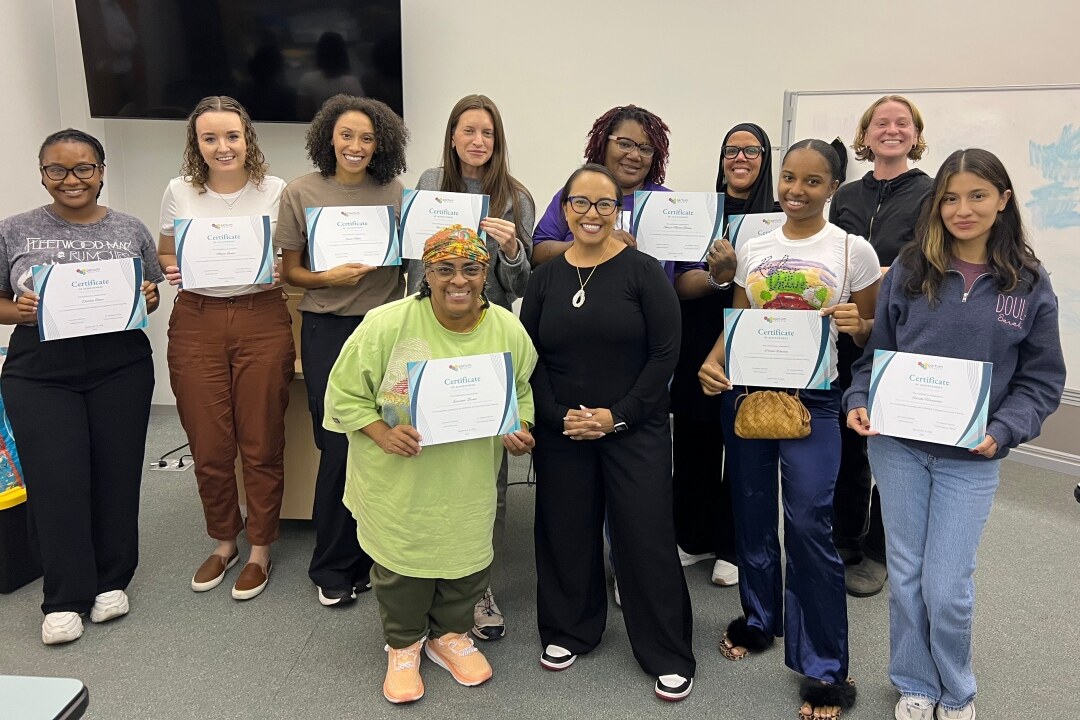
Doulas are non-medical professionals who support parents and families through pregnancy, birth, postpartum, and beyond. When you become a doula, you join a profession rooted in support, compassion, and advocacy. You use practical skills to provide person-centered care to families, helping them navigate the important transition to new parenthood.
This article will give you a full guide to becoming a doula, including training and certification options, timeline, costs, and more.
Starting your career as a doula
People come to doula work from all walks of life and diverse professional backgrounds. You don’t need to have previous experience with medical work, carework, or even with babies! Many doulas are already parents, but others are not. What matters most is a commitment to supporting families with care and non-judgment.
Requirements to become a doula
There are no uniform requirements to become a doula. The word “doula” was coined in the perinatal context by anthropologist Dr. Dana Raphael and derives from a Greek word meaning “female slave.” Doula is not a protected title and can be used by anyone at any time. Still, the term “doula” is most often used only by people who have pursued training and often, certification.
Certification is not required to practice as a doula in any US state, although being certified may give you more credibility and also allow you more options for your work, as well as the ability to charge higher rates. Generally, if you want to accept any kind of insurance or benefits for payment, such as Medicaid or employer benefits like Carrot or Maven, certification is required.
Why become a doula
Doula care is evidence-based and linked to lower intervention rates in birth, higher satisfaction rates with the birth process, and better outcomes for both mothers and babies. And no, being a doula is not like being a midwife! While midwives are clinical care providers who give medical care to mothers and babies, doulas focus solely on informational, emotional, mental, and physical support and do not perform any medical tasks.
Working as a doula has real benefits for doulas themselves, too, like flexibility and the ability to do work that fits your lifestyle. Doulas generally set their own schedule and rates and choose which clients they want to work with. As a doula, you can choose whether or not you want to work alone or with a partner, group, or agency.
With over 27 states (plus Washington DC) now requiring Medicaid to reimburse for doula services, there is a pathway for doulas to serve even more families and make a living wage providing care. As Medicaid access to doula care continues to expand, the demand for doulas will increase, making it a profession with true possibility of growth.
There are many reasons why you might want to become a doula. Maybe you have always been interested in babies and birth. Maybe you want to serve your community in a personal way. Whatever your why, doula work is deeply rewarding and makes a real difference in people’s lives.
Doula training
Unlike clinical professions, doula training is not standardized. Generally, doula training programs include a period of didactic learning followed by self-directed learning and an experience component, such as attending a certain number of births or supporting postpartum families.
Birth doula training
Birth doula training is focused on teaching new doulas how to be knowledgeable and supportive advocates during pregnancy and birth. Often, doula training happens in a short time, such as a weekend workshop in-person with additional requirements after the training. Student birth doulas will learn about the childbirth process and the physiology of labor, comfort measures for labor, common labor procedures and interventions, the postpartum period, breastfeeding, and communication skills.
Generally, people who want to become a birth doula will need to take childbirth and CPR classes, read books on perinatal topics, study breastfeeding, learn about the resources available to families in their area, and more. Usually, student doulas who want to become certified will also need to attend their first few births and submit evaluations of their work to the training organization.
Postpartum doula training
Postpartum doula training centers on the care of the new mother and family after birth. Postpartum doula training can happen in an in-person workshop, as well as online or over a longer period of time. People studying to be postpartum doulas will learn about normal postpartum physiology, newborn care and behavior, feeding and lactation support, emotional and mental support during the postpartum period,including perinatal mood and anxiety disorders, and more.
Generally, student postpartum doulas will need to take classes in CPR and infant care, study breastfeeding and other aspects of infant feeding, read books on the postpartum period, and learn about community resources for families in their area. Usually, postpartum doulas who want to become certified will provide a certain number of hours of care to postpartum families and submit evaluations of themselves to their training organization.
Other types of doula training
You may also come across trainings for other aspects of reproductive care, like fertility, infant loss and miscarriage, abortion, and more. These trainings may be part of full-spectrum doula training, which means the doula is trained to provide care and support across the full reproductive life cycle, from preconception to birth and postpartum.
You may also have heard of death doulas. A death doula, sometimes called an end-of-life doula, is a professional who helps someone navigate the experience of dying, including spiritually, emotionally, physically, and logistically. Generally, the scope of work of a death doula is separate and is not covered by birth and postpartum doula training.
How to choose a training that is right for you
There are many doula trainings available today. From local organizations rooted in the community to national training programs that have existed for decades, you are sure to find a training organization that works for you.
It is important to find a doula training that fits into your life. For some new doulas, that might be an in-person training while for others, online could be easier. You should also look for a doula training that is in alignment with your values and interests. For example, some organizations have a greater focus on business, which could be useful if you know you would like to work as a doula running your own small business. Others are more focused on advocacy, providing culturally-rooted care, or serving specific communities.
If you know you would like to accept Medicaid for your doula services, it will be key to choose a doula training that is approved by the state where you live. For example, in Illinois, there are 29 organizations you can train with to make sure you can eventually accept Medicaid insurance. One of them is EMBRACE, Partum Health’s doula training and certification program, which was designed by both doulas and an experienced OBGYN.
Doula certification
It is not required to be certified to practice as a doula. Still, there are a lot of benefits to certification as a doula. People choose to become certified for many reasons, including:
- Credibility: Certification can reassure clients and the community that you have verifiable training and skills.
- Greater access to clients: Many families themselves prefer doulas who are certified. Plus, most community doula programs or agencies also require doulas be certified in order to work with them
- Insurance, reimbursement and other programs: Certification is often required to accept insurance, including Medicaid, as well as to work with employer programs, community programs, or grants.
- Professional development and community: Most organizations that train and certify doulas offer continuing education and support from fellow doulas.
Steps to become a certified doula
The process to become a certified doula will vary based on the organization you decide to train and certify with, but for most people, the steps look something like this.
- Attend initial doula training, either online or in-person
- Complete required reading and additional classes, such as a CPR class
- Complete any required essays or exams
- Serve the required number of families for birth support or postpartum care
- Submit evaluations and other paperwork to certifying organization
- Pay certification fees
- Receive certificate
- Congratulations, you are ready to practice as a doula!
Doula recertification
Many certifying bodies for doulas, such as DONA, require recertification every few years. Recertification generally requires attending a certain number of births or supporting a certain number of postpartum clients, as well as completing continuing education classes, which can often be done online.
FAQs about becoming a doula
How long does it take to become a doula?
It depends! Some training agencies consider you a full doula after just a weekend training, while other trainings last months or even years. Generally, doulas study for some time to gain experience and confidence before going into full practice as a doula. Some doulas may mentor or apprentice with more experienced doulas while they work on certification.
How much does it cost to become a doula?
Becoming a doula typically costs from around $300 up to $3000, depending on the training organization you choose. Costs vary widely, as does what each training includes. Look for one that fits not only your goals, but your budget.
You will also be responsible for the costs of any materials, like books, supplies to take to births or to use with postpartum families, as well as exam or certification fees. Many organizations offer scholarships or sliding-scale fees to make training more accessible.
What is it like to work as a doula?
Life as a doula can look quite different depending on how, when, and where you are choosing to work. You may be a solo doula with your own practice doing just births or supporting only postpartum families. You might work with an agency, or doula part-time while maintaining other employment. You might take a lot of birth clients, meaning you are on call for large chunks of your time, or you may only attend births occasionally. You might do both birth and postpartum care as a full-time doula.
The options are endless! What it is like to work as a doula will be different for every doula depending on their goals, lifestyle, and the focus of their work.
How much does a doula make?
Generally, a doula will make anywhere from $800-3000 per birth. Postpartum doulas charge an hourly rate for their work, usually starting at $25 an hour and up. Doula rates and fees can vary depending on multiple factors, including geographic area, certification, level of experience, specialities and other training, and more. Your earning potential will also vary based on how many clients you accept.
Most doulas are self-employed or work as contractors, so they do not receive salaries and benefits. This is different from household employees like full-time nannies or housekeepers who typically receive a regular paycheck and have paid time off.
Carrie Murphy is writer, mother, doula, poet, herbalist, and advocate. Body literacy, body autonomy, and reproductive justice inform all of her work in the world—from her writing to her support of pregnant, birthing, and postpartum people. She believes that all people should have access to knowledge, tools, and support in order to live healthy lives and make informed decisions.


Related articles




Let us care for you
Treat yourself to a better fertility, pregnancy and postpartum experience.


