
Doula vs Midwife: What’s the Difference?

Bringing a baby into the world is an exciting journey, and you deserve to have the right support every step of the way! If you’re planning your birth journey (or just starting to explore your options), understanding the specific roles doulas and midwives play will help you feel confident and empowered. Both professionals offer incredible support, but in different ways - and in learning about their unique qualifications, you can choose the best team for your pregnancy, birth, and postpartum experience.
What is a Doula?
A doula is a trained professional who provides emotional, physical, and informational support to pregnant women before, during, and after birth. Unlike medical providers, doulas do not offer medical advice or perform clinical tasks. Instead, they focus on comfort measures, advocacy, and continuous practical support throughout the birthing process and postpartum.
Types of doulas include:
- Birth doulas: These doulas support you during pregnancy and birth. They help with birth planning, and provide continuous emotional, mental, physical and informational support during labor and delivery.
- Postpartum doulas: Postpartum doulas provide care to both newborn infants and their families during the postpartum recovery period, including during the day or overnight shifts (sometimes informally referred to as “night nannies”). They are experts in the fourth trimester and can help with all aspects of newborn care as well as care of the mother after birth.
- Fertility doulas: Fertility doulas provide support to people pre-conception. This can mean support for people who are undergoing fertility treatments or not.
- Bereavement or loss doulas: These doulas are trained in reproductive loss including miscarriage, stillbirth, and neonatal loss. They support families undergoing these experiences before, during and after, including attending births and providing emotional and other kinds of support.
- Full-spectrum doulas: Full spectrum doulas are trained in all aspects of doula care, including fertility, birth, loss, postpartum and more. They can support people throughout their reproductive experiences, aka “full-spectrum” of pregnancy and postnatal care. Here at Partum, we train our doulas in full-spectrum care.
It’s important to carefully vet candidates when hiring a doula. “Doula” is not a protected title, meaning a state license is generally not required to practice as a doula. To use the title of Certified Doula (CD), however, requires completion of a doula certification program, which includes a set number of hours of live instruction, a written exam, references from both families and supervisors, and regular recertification.
Doula training varies, but most programs emphasize hands-on techniques, emotional support strategies, and birth plan guidance. Although certification is not required, many doulas choose to complete training programs to enhance their expertise.
What is a Midwife?
A midwife is a trained healthcare professional specializing in pregnancy, birth, and postpartum care. Midwives offer medical care and are qualified to provide prenatal care, monitor fetal development, and manage labor and delivery for low-risk pregnancies. Midwives often collaborate with OB-GYNs for comprehensive maternity care.
Types of Midwives
Generally speaking, there are four types of midwives practicing in the United States:
CNM Certified Nurse Midwife
These are nurses who have completed an additional graduate degree in nurse midwifery. They are qualified to work in all birth settings including hospitals, homes, and birth centers. Certified nurse midwives can prescribe medication in all 50 states. They also provide other types of reproductive and well-woman care like include physical exams, pelvic/breast examinations, STI screenings, Pap smears, family planning.
CM Certified Midwife
Certified midwives have the same graduate training as certified nurse midwives, although they often have a background in an educational area other than nursing.They take the same exam to qualify as nurse midwives. They are currently authorized to practice in 12 states.
CPM Certified Professional Midwives
Certified professional midwives only work in out-of-hospital birth settings, such as homes or hospitals. They have usually completed training through coursework and an apprenticeship and are also required to take a national exam. CPMs can refer you to other providers, but they cannot prescribe medication. They are currently licensed to practice in 37 states.
Traditional midwives
Traditional midwives have chosen not to pursue licensure as a midwife in the United States. They may or may not have training in midwifery, as their training and background can vary greatly from midwife to midwife. Traditional midwives may serve certain communities, like the Amish.
Depending on what you are planning for your birth, where you live, and what your insurance may cover, you may choose any of these types of midwives to support you.
Doula vs Midwife: Key differences
Understanding the distinctions between a doula and a midwife can help expecting families determine which professional best meets their needs. While both doulas and midwives support pregnant individuals, their roles differ significantly.
Midwives provide medical care, including prenatal checkups, labor management, and postpartum medical support, whereas doulas focus on emotional and physical support without medical intervention. Both professionals assist with birth planning, but a midwife can also provide clinical guidance and medical interventions when necessary.
Doulas offer continuous emotional support during labor, while midwives split their focus between medical care and emotional well-being. In the postpartum period, doulas continue offering non-medical support, such as newborn care and parenting education, while midwives handle medical checkups for both the birthing person and the baby.
Additionally, midwives are essential for those seeking home birth or birth center options, as they are trained to manage labor in these settings safely. If a birthing person requires medical intervention beyond a midwife’s scope, they may collaborate with an OB-GYN to ensure proper care.
Doula vs. Midwife vs. OB-GYN
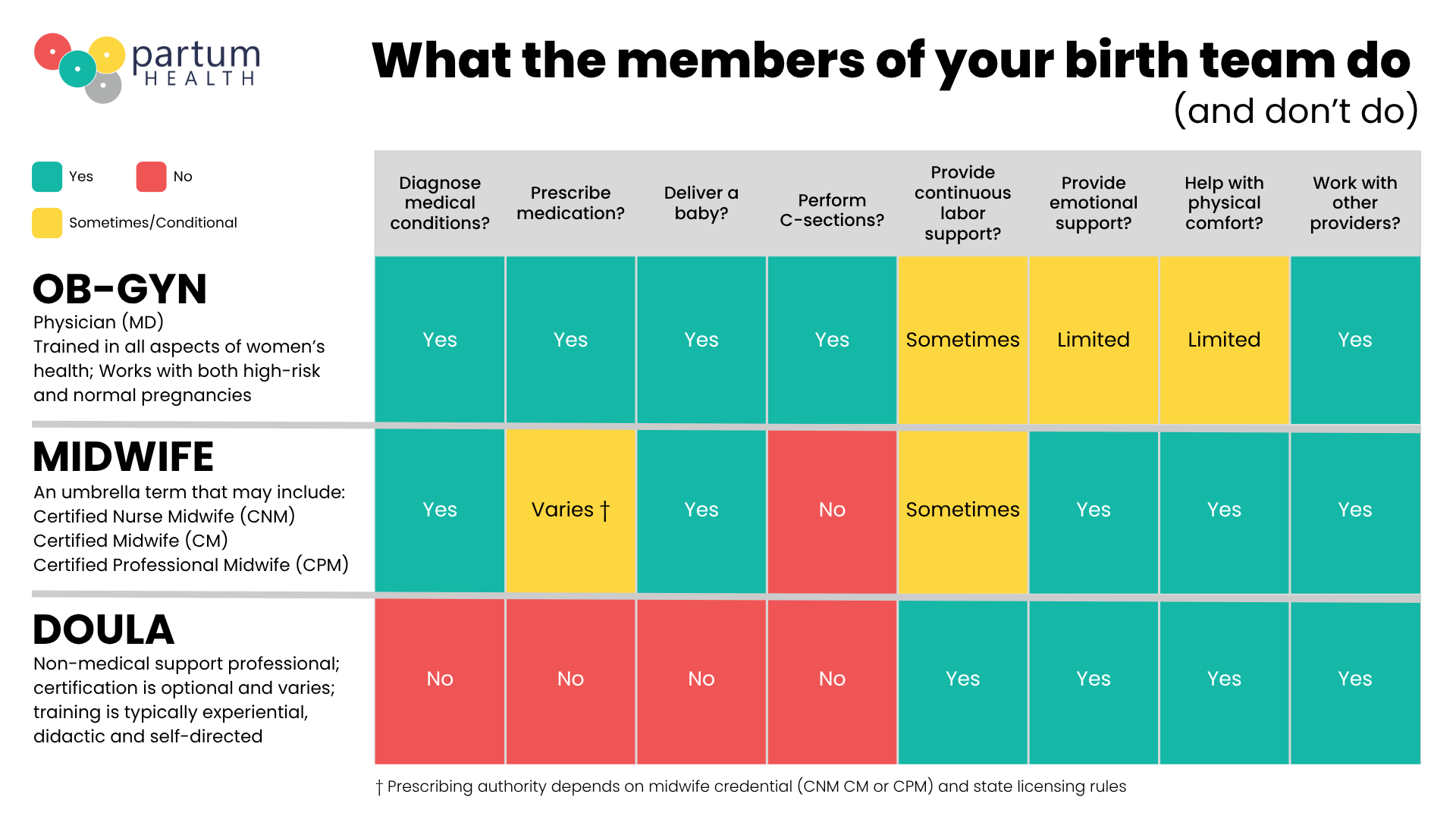
How do OB-GYN physicians come into play when working with doulas and midwives? Here's the lowdown on what a doula does versus a midwife versus an OB-GYN.
OB-GYN
Obstetrician-gynecologists are women's health physicians who are trained in all aspects of women’s health, including pregnancy and birth. They work with women who are having both normal and high-risk pregnancies. They can perform surgeries such as Cesarean sections and use forceps and or vacuums during vaginal birth.
Midwives
Midwives are medical professionals who specialize in normal and low-risk pregnancies. They see pregnancy as a normal life event and provide whole-person care throughout the childbearing year. In general, a midwife will collaborate with an OB if complications arise in someone's pregnancy.
Doula
A doula is a trained non-medical support person who provides emotional, mental, physical and informational support throughout the experience of pregnancy, birth and postpartum. Typically they work as a team with midwives and/or OBGYNs to help people have happy healthy births.
Cost and Insurance
In general, the costs of a doula versus midwife are not comparable. Because midwifery care is comprehensive medical care, it is much more expensive than doula care.
Insurance plans will cover midwives who work in a hospital setting (a CNM or CM), while midwives who work in a birth center or home birth setting may or may not be covered. If you're interested in coverage for out-of-hospital midwifery care, you should check out your insurance plan.
In general, home birth care from midwives is paid out of pocket and costs start at around $5000 for all care, including prenatal, birth, and postpartum.
Doula care can range in costs depending on where you live, the experience of your doula, and more. In general, doula care starts at around $500 and can be up to $2500 dollars or more. Historically, doula care was paid out of pocket but Medicaid now covers doula care in 27 states plus Washington DC.
You may also be able to use your FSA or HSA for midwifery or doula care.
Can You Have Both a Midwife and a Doula?
You may be wondering if you can have both a midwife and a doula support you throughout pregnancy. The answer is yes! The roles that doulas and midwives play are distinct and complementary, so having both can ensure you have an even better pregnancy, birth, and postpartum experience. Remember that midwives provide medical care and doulas provide emotional and mental support - two different things!
A doula does not replace a midwife and vice versa. The decision is not either or. Most people will benefit from experiencing the midwifery model of care, as well as the personalized support that a doula provides.
Research and Outcomes Data for Doulas and Midwives
There are lots of evidence-based reasons why you might want to choose doula care, midwifery care, or both!
Midwifery care is associated with a lower rate of Cesarean sections. A 2024 Cochrane review of 17 trials and over 18,500 women found that midwife-led continuity of care increased spontaneous vaginal birth and reduced cesarean sections. A large meta-analysis of 1.4 million pregnancies confirmed lower rates of both unplanned cesarean and instrumental vaginal deliveries with midwife-led care. Women who had midwives as their providers also had lower rates of intervention during their labor and birth and shorter hospital stays.
Research also finds that families who had midwifery care have higher rates of satisfaction as compared to standard care. One randomized trial found that caseload midwifery was associated with 3.4 times higher odds of satisfaction with prenatal care and 2.1 times higher odds with labor care.
Care from a doula is also associated with significantly lower chances of having a cesarean birth. A Cochrane review found that women with continuous doula support were 25% less likely to have a Cesarean birth, while a Medicaid study found 41% lower odds of cesarean delivery with doula care. A large cohort study of over 17,000 deliveries also found significantly more vaginal births after cesarean (VBAC) , roughly 15 to 34 additional VBACs per 100 patients who had doula care. A Cochrane review also found that women who had doulas had slightly shorter labors.
Doula care is also linked to fewer preterm births, better rates of breastfeeding, and better mental health during pregnancy and after birth.
Questions to Ask When Hiring a Doula or a Midwife
You can and should ask questions when you are thinking of hiring a doula, a midwife, or both. Here are some of our suggestions on how to get the conversation started.
Questions for a potential doula:
- What trainings or certifications do you have?
- How many births have you attended or postpartum families have you supported?
- What is your philosophy on supporting people in birth?
- What happens if you're unavailable when I go into labor?
- Do you offer postpartum support?
- What are your fees and do you accept insurance/HSA/FSA?
Questions for a potential midwife:
- What is your certification type (CNM, CPM etc)?
- Which hospitals or birth centers do you have privileges at, if any?
- How do you handle complications or emergencies?
- Do you collaborate with OB-GYNs? If so, who? How does it work?
- Is your care covered by my insurance?
- What is your Cesarean rate?
Whether you decide to work with a doula, a midwife or both, incorporating one or more of these perinatal professionals into your care will likely help you have a better experience during your pregnancy, birth, and postpartum.
Looking for a doula? Partum Health matches families with vetted birth and postpartum doulas in Chicago, Detroit, Dallas, and Houston. Get started now!


Related articles




Let us care for you
Treat yourself to a better fertility, pregnancy and postpartum experience.


