

Round Ligament Pain in Pregnancy: What It Feels Like, What Causes It, and How to Find Relief
Medically reviewed by Dr. Melissa Dennis, MD, MHA, FACOG
What Is Round Ligament Pain?
Ever had a sharp, stabbing pain around your lower belly when you’re pregnant? That’s called round ligament pain—and it’s incredibly common! Round ligament pain affects up to 90% of pregnant women.
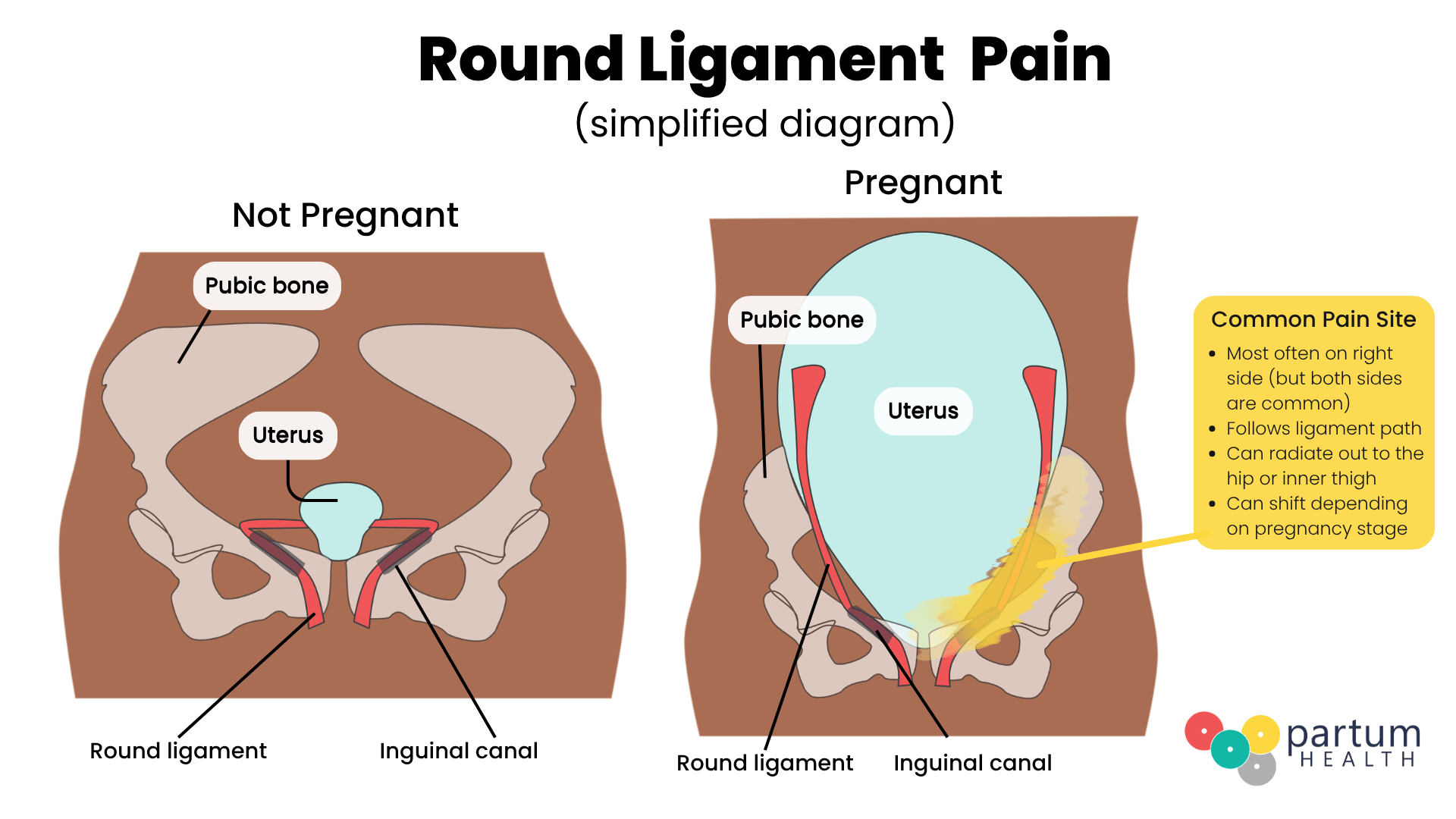
The round ligaments are two rope-like bands of connective tissue on either side of the uterus. They connect the front of the uterus to the groin, and anchor the uterus in place while still allowing it to move. During pregnancy, as the uterus grows from the size of a pear to the size of a watermelon, these ligaments stretch and thicken.
That stretching is what causes round ligament pain, which is usually felt as a sharp, sudden, stabbing sensation or a dull ache, usually felt in the lower belly or groin, typically on one side. It can happen due to quick movements, like coughing, sneezing, laughing, rolling over in bed or even getting up too quickly.
Round ligament pain is one of the most common pregnancy pains, especially in the second trimester (when your uterus is doing a lot of growing!). It doesn’t cause any harm to you or your baby, although it is certainly annoying and inconvenient. Round ligament pain can sometimes occur outside of pregnancy (in anyone with a uterus), although it’s much less common.
What Does Round Ligament Pain Feel Like?
Round ligament pain feels like a sharp, sudden, stabbing or pulling pain. It’s often triggered by a quick movement. It is usually brief, lasting just a second or a few minutes. Sometimes, it presents as a dull or ache-y soreness that can linger, especially if you’ve been extra active. The pain is located in the lower abdomen, groin, and sometimes can radiate out towards the tip.
Though it can occur on both sides of the body, round ligament pain is often felt on the right side. This is because the uterus more commonly leans to the right during pregnancy (dextrorotation), and this puts more strain on the round ligament on the right side.
Round ligament pain does not feel like cramps. It tends to be sharper and triggered by movement, while cramps in the uterus are more rhythmic and are not movement dependent.
Where Exactly Is Round Ligament Pain Located?
Round ligament pain happens in your lower abdomen, usually below the belly button and near to the groin. It can happen more on the right side, but both sides are possible. The pain follows the path of the ligament, so from the front of the uterus, through the lower abdominal wall, and down into the groin. Sometimes, it can radiate out to the hip or inner thigh.
As your pregnancy progresses and your uterus grows, the exact location of the pain may change a bit (getting higher or lower). But the general sensation should stay the same.
When Does Round Ligament Pain Start — and When Does It Stop?
First trimester: Round ligament pain isn’t typical in the first trimester, but it can occur in the later few weeks (weeks 10-12). It’s also more common if you’re having a subsequent baby, as the uterus tends to get larger faster after you have already given birth. Round ligament pain in early pregnancy can be normal, but if you are having sharp lower abdominal pain on a regular basis, it’s good to be seen by a medical provider to rule out ectopic pregnancy.
Second trimester: Round ligament pain usually peaks in the second trimester, often between weeks 14-20, when the uterus is growing the fastest and shifting out of the pelvis into the abdomen. The ligaments on both sides of the uterus are stretching the most during the second trimester.
Third trimester: You can expect to have some round ligament pain in the third trimester as well, but it might change to be more of a dull ache than a sharp stabbing. This is because your uterus is heavier overall and the pain is more from the weight on the ligaments than the growing of the uterus.
After giving birth: Round ligament pain should completely resolve after birth as the uterus shrinks and the ligaments go back to their normal state. It takes weeks for the body to reset, but that doesn’t mean you will be having pain during that time.
What Causes Round Ligament Pain?
Round ligament pain is a normal part of pregnancy for the majority of people. It happens because of the changes going on in the pregnant body.
Specifically, rising progesterone and relaxin hormones cause the round ligaments (which are made of smooth muscle and connective tissue) to soften and become more elastic. As the uterus grows, the ligaments stretch from their normal length of a few inches to more than twice their normal length. When you move quickly, the ligaments contract and release rapidly, causing a sudden sharp pain. A dull aching pain is possible, too, especially after lots of movement.
Triggers for round ligament pain include sudden changes in position (like standing up quickly or rolling over in bed), exercise, long periods of standing or walking, having sex, or even sometimes sneezing, coughing, or laughing.
Round Ligament Pain vs. Other Pregnancy Pains
It’s common to wonder if the pain you’re feeling during pregnancy is normal or indicates a problem.
Round ligament pain vs. contractions: Round ligament pain is sharp and triggered by movement while contractions are rhythmic, come in waves, and involve the entire uterus tightening. Contractions are not typically triggered by something like a cough, laugh, or a positional change, and are more common in the third trimester
Round ligament pain vs. Braxton Hicks: Braxton Hicks feels like the belly tightening or hardening, usually with a squeezing sensation. Round ligament pain is a sharp pull or stab in the lower belly/groin. Braxton Hicks affects the whole uterus and are more common in the third trimester, while round ligament pain is typically localized to one side and happens in the second trimester.
Round ligament pain vs. cramping: If you experience cramping that is rhythmic, increasing in frequency, or accompanied by pressure, bleeding, or fluid leaking, this is not round ligament pain and you should contact your provider immediately. It may indicate pregnancy loss or preterm labor depending on how far along you are in your pregnancy.
Other conditions can cause pain in the belly and groin during pregnancy, like ectopic pregnancy, a UTI (urinary tract infection), appendicitis, ovarian cysts, or placental abruption. If the pain you are experiencing is constant or getting worse, or if you develop bleeding or a fever, you should call your medical provider, as this is not round ligament pain.
How to Relieve Round Ligament Pain
Round ligament pain isn’t unusual, but that doesn’t mean you have to suffer through it! There are plenty of comfort measures that can help you feel better when you are experiencing round ligament pain.
In the moment
- Pause and change position slowly. If you’re standing, move to sitting, or vice versa.
- Flex your hips before you cough, sneeze, or laugh (this pre-engages the ligament and may reduce the sudden pain).
- Apply gentle pressure with your hand where the pain is.
- Apply a hot water bottle, heating pad, or warm compress (like a washcloth dipped in hot water) on the lower abdomen. Make sure it isn’t too hot and be sure to do this for just a few minutes at a time to avoid overheating the area.
- If a dull ache or pain continues, ask your provider about taking a medication such as acetaminophen (Tylenol) to help with the discomfort.
In your daily life
- Avoid sudden movements. That means roll slowly out of bed, stand up gradually, etc.
- Try a pregnancy belly band, which can reduce the pulling weight on the ligaments and relieve some of the weight of the belly.
- Try kinesiotaping on your belly, which works similarly to a belly band.
- Take a warm bath.
- Take a prenatal yoga class and try gentle stretching. Poses like cat-cow, supported side stretches and pelvic tilts should feel really good.
- Stay active with low-impact exercise, like walking or swimming.
- Book a prenatal massage, which can lessen tension all over your body.
- Take over-the-counter medications like acetaminophen (Tylenol). This is generally considered safe, but always check with your provider first to make sure.
If your round ligament pain is recurring or starts to feel like it’s interfering with your daily routine, consider seeing a physical therapist. A physical therapist who specializes in the perinatal period and the pelvic floor can help.
Laura Gleason, a DPT based in Chicago with more than twenty years of experience, says, “An individual assessment of the pregnant person’s movement patterns, posture, and muscle imbalances can help guide specific treatment and exercises. Often, adjusting how someone habitually stands or moves can make a big difference, but sometimes external support is also helpful, like a belly support or kinesiotape. ”
A PT will assess your posture, core engagement, and teach targeted exercises to alleviate the pain. They can be especially helpful for people who are on their feet a lot or are carrying multiples.
Laura also recommends bringing more awareness to your regular movement to help mitigate round ligament pain. “Some things that people can do daily are to move more mindfully and use the core more effectively. This can look like exhaling and gently engaging the lower abs by “hugging the baby up and in” when getting out of bed or lifting heavy groceries for example. Gentle stretches like cat cow, pelvic tilts and circles while sitting on an exercise ball, and hip flexor stretches can often be helpful for most people as well.”
When to Call Your Healthcare Provider
If you are having pain in your belly, lower abdomen, or groin, call your provider right away if you notice any of the following:
- Pain that is constant and doesn't go away with rest or position change
- Severe pain that worsens over time
- Pain accompanied by fever, chills, or nausea/vomiting
- Pain with vaginal bleeding or spotting
- Pain with burning during urination
- Pain with contractions (regular tightening)
- Fluid leaking from the vagina
- Pain that feels different from anything you've experienced before in this pregnancy
It’s always better to call or be seen than to wait, especially if something doesn’t feel right in your body. You know yourself best, including what is normal for you. Your provider is used to these type of calls and is happy to help you.
Round Ligament Pain FAQs
Can round ligament pain be constant?
Usually, it isn't: the sharp stabbing pain should last just a few seconds. A dull ache can linger for hours, especially if you've been super active that day. If pain is truly constant, contact your health care provider to rule out other causes.
Can you have round ligament pain and not be pregnant?
It's possible, though not common, to experience round ligament pain outside of pregnancy. Ligaments can spasm or become irritated from exercise, or even endometriosis or other pelvic conditions. If you're having persistent pain in your vagina, groin, or lower abdominals, you should see your health care provider.
Is round ligament pain worse with twins or multiples?
It certainly can be! When your uterus is larger and heavier (like when you're carrying multiple babies) the ligaments around it experience more strain. People carrying multiples may experience round ligament pain earlier and more intensely.
Does round ligament pain mean the baby is growing?
To some extent, yes. The pain is caused because the uterus is expanding, but it's not a direct result of your baby's growth and doesn't indicate anything about their size. Some people have a lot of growth without round ligament pain, while others experience a lot of pain with not much growth.
Can exercise make round ligament pain worse?
Yes, high impact exercise can trigger round ligament pain. Low impact activities like walking, swimming, or yoga can be helpful if you're trying to prevent or heal from round ligament pain. A physical therapist can also help you find exercises that don’t exacerbate the pain.
Is it round ligament pain or something serious?
Here's how you can tell the difference between round ligament pain and truly problematic pain: Round ligament pain is short, sharp, often triggered by movement, and resolves with rest. Pain that is severe, constant, getting worse, or is accompanied by bleeding, fever, or contractions, means you should call your doctor or midwife.
Carrie Murphy is writer, mother, doula, poet, herbalist, and advocate. Body literacy, body autonomy, and reproductive justice inform all of her work in the world—from her writing to her support of pregnant, birthing, and postpartum people. She believes that all people should have access to knowledge, tools, and support in order to live healthy lives and make informed decisions.


Related articles




Let us care for you
Treat yourself to a better fertility, pregnancy and postpartum experience.


