
Diastasis Recti: What it is, how to check for It, and how to heal It

Medically reviewed by Dr. Melissa Dennis, MD, MHA, FACOG
You know that “mommy pooch” in your belly, the one that never seems to go away, no matter how much you tweak your diet and exercise routine? It could very well be diastasis recti, which is a separation of the “six pack” abs (rectus abdominus) that is incredibly common during and after pregnancy. The good news is, the majority of the time, diastasis recti can be healed with time and corrective movement.
What Is Diastasis Recti?
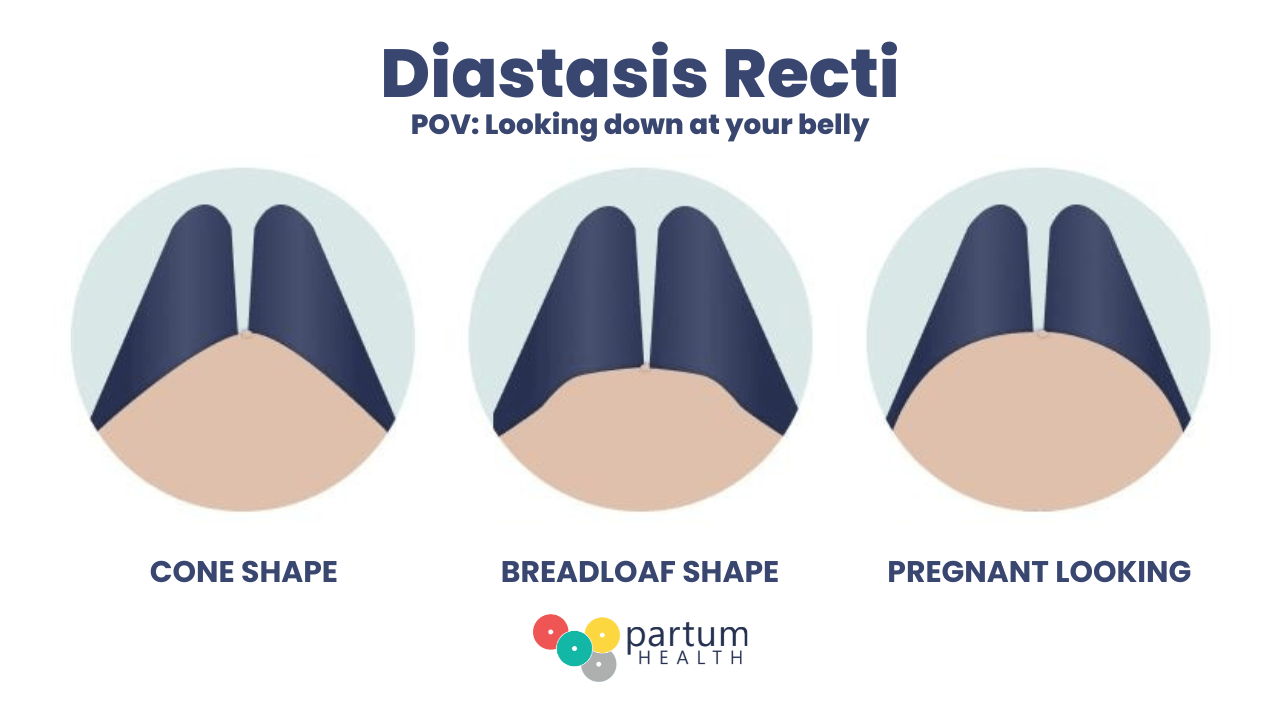
Scientifically, diastasis recti abdominis (DRA) is defined as the separation of the two rectus abdominis ("six-pack") muscles along the linea alba, the midline connective tissue of the anterior abdominal wall. In real life, it can look and feel like a bulge in your midsection, a “pooch” that doesn’t change, or a doming or coning in your midsection that occurs with movement.
Diastasis is not a hernia or a tear, although it is sometimes confused with both. It happens when the linea alba thins and widens combined with laxity in the abdominal muscles, causing a visible midline "bulge" when pressure in your abdomen increases.
Diastasis is most commonly associated with pregnancy, especially a pregnancy with multiples or a subsequent pregnancy. It can also affect men or women who have never been pregnant especially if they lift heavy weights often or have chronic abdominal pressure.
According to Alison Hayman, PT, DPT, OCS, “[Diastasis Recti] is a normal change of tissue that occurs in pregnancy, in up to 100% of people (so pretty much everyone). So it's something that I look for in everyone who is or has been pregnant.”
Among women who have been pregnant, lingering diastasis recti is very common: approximately 60% of women experience diastasis recti at 6 weeks postpartum and about 33% at 12 months postpartum. Persistent, long-term diastasis is common too, occurring in 22-36% of people at 3-30 years postpartum.
What Causes Diastasis Recti?
One of the most common causes of diastasis is pregnancy. This is because of two things: one, during the process of growing a baby, the uterus enlarges and pushes the abdominal muscles apart; and two, the hormonal changes of pregnancy can soften connective tissue.
That doesn’t mean every pregnant person will get the condition, of course. You may have a higher chance of experiencing diastasis recti if you:
- Are carrying multiples, like twins or triplets
- Have had pregnancies close together
- Are over age 35 at the time of pregnancy
- Are obese
- Are having a subsequent baby, e.g. not your first
- Have experienced heavy or repeated straining, like a chronic cough, constipation or heavy lifting
Some people may be more genetically predisposed to get diastasis recti than others, regardless of fitness level before, during, or after pregnancy.
What Does Diastasis Recti Look and Feel Like?
Diastasis recti shows up differently in different bodies, but in general, it presents as a bulge or ridge running down the midline of the belly or an abdominal “pooch” that doesn’t change with diet or exercise. The bulge or “pooch” may be more visible when sitting up or straining. You may feel you always appear bloated or puffy in your stomach area.
“Typically in pregnancy, it looks like coning in the abdominal area with putting force through the muscles, like doing a crunch. After pregnancy, it can feel like a space between the sides of the ab muscles,” says Dr. Hayman.
Other symptoms include lower back pain, poor posture, a feeling of core weakness, pelvic floor dysfunction (like leaking or heaviness) and abdominal pain. You may also feel it’s difficult to do activities that require your core, like lifting, bending, and transitioning from lying to sitting.
Lots of mothers feel frustrated or self-conscious about their diastasis or like it’s their fault they developed this condition. Developing a diastasis is not a failure! It’s very common and can be treated relatively easily.
How to Check for Diastasis Recti at Home
Your doctor or midwife can assess you for diastasis as soon as six weeks after giving birth. But if your postpartum visit is long passed, you can still check for diastasis at home. Here’s how.
- Lie on your back with knees bent and place your fingers just above the belly button, pointing downward.
- Lift your head and shoulders slightly off the floor and feel for a gap between the two ridges of muscle. Make sure you exhale fully before lifting, as this relaxes the abdominal wall and makes the gap easier to feel accurately. Avoid holding your breath during the check. The gap you may or may not feel will be measured in finger widths. 1 finger is normal and 2+ fingers suggests that you have diastasis recti.
- You can also note how far your fingers sink before meeting resistance and the firmness of the tissue (springy vs. soft and yielding). You can check at three points: above the navel, at the navel, and below the navel — these may feel similar or significantly different.
A self-check gives a basic assessment as to what’s going on in your body, but if you want to get a full diagnosis, make an appointment with your physician, midwife, or a physical therapist (especially one who specializes in pelvic floor therapy). These professionals can measure more precisely and feel the tension in your linea alba, which can matter as much or even more than the width of the gap in your abdominals.
“The biggest factor to look for is not actually the space between the ab muscles, but how much tension there is in that space,” says Dr. Hayman. “If you can push your fingers down toward your back easily, there is not a lot of tension and that is what needs to be worked on. Initially the focus is on learning how to create tension and work that area in a way that helps it get stronger.”
Diastasis Recti During Pregnancy
Can you prevent diastasis recti? Not really, but you can take steps to lessen the severity.
Most people will have some degree of diastasis recti during pregnancy. This is because as the belly grows, abdominal separation is expected. The separation will often become more noticeable in the third trimester, especially as mobility (including things like getting out of bed!) becomes more difficult.
If you want to minimize your chances of developing a more serious diastasis, there are some things you can do during your pregnancy:
- Avoid situps and other exercises that put pressure on the core
- Be careful of how you move your body when going from lying to sitting or when getting out of bed: turn to the side and roll, rather than getting straight up.
- Support your belly during movement or exercise.
For the best support for movement during pregnancy, work with a physical therapist or personal trainer who has special training in the perinatal period.
Dr. Hayman says, “The first thing is to try to minimize your risk of persistent DRA, which means DRA symptoms that do not resolve by 6 months postpartum. Strengthening exercise in pregnancy is the one thing that has good evidence behind it to reduce or prevent the risk of persistent DRA.
“The second is to do specific abdominal strengthening in postpartum. Working the muscles with good form and control puts good stress on the stretched tissue and helps it rebuild, which makes the DRA less prevalent.”
How to Heal Diastasis Recti
Healing your diastasis recti (i.e. bringing your abdominal muscles back together) involves targeted exercise and movement. Not more situps or planks, though — healing a diastasis begins with reconnecting to the deep core.
The foundation of healing a diastasis begins with diaphragmatic breathing, or learning to breathe deeply into your belly, rather than your chest. It's important because your diaphragm, your deep core and your pelvic floor muscles all work together as a team. Helping coordinate them together is the starting point for restoring core stability.
The goal of healing a diastasis isn't just to bring the gap back together (although if that's your main concern, we totally get it!). The focus is on restoring function to those abdominal muscles, including necessary tension. A narrow gap with no tension can be worse functionally than a wider gap where tissues are still responding, for example.
Usually, healing will start with breathing and breath work, then move into gentle core engagement, then progress to exercise. Exercises can include heel slides, toe taps, dead bugs, bird dogs, and modified planks. Your overall progression should be tailored to you and ideally guided by an experienced PT.
There are exercises you should avoid during your healing, including:
- Crunches and sit-ups
- Traditional planks
- Heavy overhead pressing
- Any other movements that cause doming or coning of the abdomen
These movements increase intra-abdominal pressure that pushes the separation further apart before the tissue has healed. Essentially, they can make things worse or cause a setback — not what you want as you try to heal diastasis!
Healing your diastasis is a process. Typically, it takes about 6-12 weeks of consistent corrective exercises to see some improvement. Healing can continue over months and even years. It is never too late to heal your diastasis! You can always improve feel and function, although some older ab separations may not ever completely close.
When to See a Pelvic Floor Physical Therapist
Most people can benefit from seeing a pelvic floor physical therapist after being pregnant and giving birth, for issues ranging from pain and dysfunction to yes, diastasis. If diastasis is your main issue, it’s best to see a pelvic PT if you have a more than 2 finger gap, if you are having pain and pelvic floor issues, and if you’re tried home exercises for diastasis without any improvement after 6-8 weeks.
A pelvic floor PT can assess you in a thorough way, taking into consideration your health and pregnancy history, scar tissue (especially if you had a Cesarean birth), and much more. Their care is hands-on and comprehensive. They may give you exercises to do in-office and at home and suggest other ways to move or not move your body that can assist with healing.
There are lots of online programs that can also help heal your diastasis, but if you can, it’s definitely best practice to see a therapist who can assess you and your needs as an individual. Most insurance companies will cover pelvic floor PT with a referral from your primary care provider, OB, or midwife.
When Surgery Is Needed
The vast majority of women and people with diastasis recti can see great improvement with physical therapy and exercise alone, even if it’s been years since pregnancy and birth.
Still, surgery may be the best option for some. Surgery can be indicated when the separation is severe (greater than 2.5-3cm), when physical therapy has been exhausted without improvement, or when there is also a hernia. The surgery involves sewing the two sides of the linea alba back together, and in the case of excess skin, an abdominoplasty may be recommended to remove that skin at the same time.
Insurance will sometimes cover this type of surgery, especially if there is a documented issue like a hernia, chronic pain, or loss of function. Typically, insurance won't cover it for cosmetic reasons. If you want or need surgery, PT is still recommended before and after for the best outcomes for your body.
Diastasis Recti FAQs
Can diastasis recti heal on its own?
Sometimes mild cases do resolve in the early months after giving birth or up to a year. Typically, moderate to severe ab separation typically needs targeted support and exercise. It won't necessarily get worse if you don’t do anything, but it won’t get better without intervention.
Can men get diastasis recti?
Yes, men can get diastasis! It can be caused by heavy lifting, obesity, or other sources of repeated abdominal pressure. The exercises and treatment approach are the same as it would be for women.
Does diastasis recti cause back pain?
It can, yes. If your core is weaker, it can have a more difficult time supporting your spine and related muscles effectively, which can lead to a strain in the lower back. Treating the diastasis can improve issues with back pain.
What happens if diastasis recti is left untreated?
It depends. Some people won’t have any issues, while others will. Untreated diastasis can lead to other problems like back pain, poor posture, pelvic floor problems, and more.
Is it too late to fix diastasis recti years later?
Not at all! Research shows that targeted exercises can improve function and reduce the gap even years after giving birth. You may not get your pre-baby abs back, but improvement in both looks and function can happen at any point.
Can I do planks with diastasis recti?
It’s best not to, especially soon after you are diagnosed. Planks increase intra-abdominal pressure and can worsen the separation of the abs. Modified versions, however, can be great exercises — a PT or trainer can help you find a variation that is right for your body.
Carrie Murphy is writer, mother, doula, poet, herbalist, and advocate. Body literacy, body autonomy, and reproductive justice inform all of her work in the world—from her writing to her support of pregnant, birthing, and postpartum people. She believes that all people should have access to knowledge, tools, and support in order to live healthy lives and make informed decisions.


Related articles




Let us care for you
Treat yourself to a better fertility, pregnancy and postpartum experience.


